
1 条题解
-
0
自动搬运
来自洛谷,原作者为

cff_0102
& aqua_qaq | 团子群 185800038 | 如果我死了说明我 AFO 了搬运于
2025-08-24 22:46:55,当前版本为作者最后更新于2023-04-27 23:55:54,作者可能在搬运后再次修改,您可在原文处查看最新版自动搬运只会搬运当前题目点赞数最高的题解,您可前往洛谷题解查看更多
以下是正文
由于停车图是递归定义的,因此有必要为问题找到递归公式。考虑串联和并联组合后,需要调用其他需要计算的函数。对于给定停车图的所有子图 ,计算对应的下面四个函数值,每个函数都代表的是可以停放在图 中的汽车总数(包括已经停在那里的汽车),使每辆停放的汽车都能以某种方式从 中出去。这些函数之间的区别主要在于汽车如何精确地从 中出去:
- : 每辆停放的汽车都能通过 的源节点离开。
- : 每辆停放的汽车都能通过 的终端节点离开。
- : 每辆停放的汽车可以通过 的源节点或终端节点离开。
- : 与前一种情况相同,但是另外还可以从 的源到终端,即存在由空停车位组成的路径连接 和 。
在上述所有函数中,可以使用特殊符号或数字(例如 )来表示对于已经停放在 中的车辆,怎么样都无法到达这种情况。
此外,为了使公式更简单,我们定义一个对于子图 的函数:
- : 如果 为空,则为 ,否则为 。
现在,需要为上述每个函数找到递归公式。这里详细解释了函数 的递归公式,并列出了其他函数的公式。大家可以自行验证其他公式。此外,会用到 $\texttt{THROUGH}\le\texttt{FORWARD},\texttt{BACKWARD}\le\texttt{BOTH}$ 这个很容易推出的式子,来减少需要考虑的情况数量。这里重申一遍,每个函数都代表的是在这种情况下,可以停放在图 中的汽车总数。在下文中,五个函数分别简称为 。
- 如果该图只包含一个节点,则 的值始终为 ,而 的值要么为 (如果这个节点没有车),要么为 (这个节点停了车)。
- 假设我们串联 得到 ,并想要计算它的 函数值。有两种可能性:至少有一辆汽车停在 中,或者 为空。在第一种情况下,必须要有一条路径让 中的汽车全部在源点退出,因此,在此情况下最多可以停放的汽车数量为 。在第二种情况下,最多可以停放的汽车数量是 ,因为 必须为空,并且 给出了该情况下最佳的安排。
- 现在,假设 是并联组合的结果,并且我们要计算函数 的值。并联组合更为复杂,因为我们还需要考虑新添加的源和终端是怎么样的。根据源和终端是否停了车,分为三种情况:
- 源被占用,终点空闲,此时, 和 都必须为空。 的值为 $1+\texttt{N(}G_1\texttt{)}+\texttt{N(}G_2\texttt{)}$。
- 源和终点都是空闲的:现在,来自 和 的汽车可以直接向前退出,或者它们可以从其中一个的两侧退出,而另一个则具有从终端到汇点的路径。因此, 的值是 $\texttt{F(}G_1\texttt{)}+\texttt{F(}G_2\texttt{)},\texttt{B(}G_1\texttt{)}+\texttt{T(}G_2\texttt{)},\texttt{T(}G_1\texttt{)}+\texttt{B(}G_2\texttt{)}$ 中最大的一个。
- 源空闲,终点被占用:其中一个子图必须要保证停在终点的车辆可以退出到源,而另一个子图的所有汽车都需要向前退出。因此, 的值为 $1+\texttt{T(}G_1\texttt{)}+\texttt{F(}G_2\texttt{)},1+\texttt{F(}G_1\texttt{)}+\texttt{T(}G_2\texttt{)}$ 中更大的一个。
即使找到了递归计算函数的所有可能规则,由于需要考虑的情况数量巨大,实现(特别是重构最优排列时)仍然容易出错。一个寄巧可以极大地简化它的实现,那就是使用常量来定义上述递归规则,见下图。

上述表格将递归计算函数的规则编码为在 C++ 中的简单整数数组。例如,第二列中的
{FORWARD,0,1,THROUGH,FORWARD}表示当 是 和 的并行组合,并且正在计算 函数时,我们需要考虑终点是否为空,终端是否被占用, 的 值是多少,以及 的 值是几。通过上述定义的常量,解决方案变得简单但仍然很长(不过还是好多了),需要实现一个解析器来将编码转换为类似树形结构的形式,然后需要递归遍历该树来计算每个函数。为了重构最优排列,我们需要记住用于获得相应函数最大值的规则索引。
下面是官方题解代码:
// CEOI 2013 - Task: Splot - Solution
// Author: Ante Derek

#include <cstdio>
#include <cassert>

using namespace std;

const int MAX = 1000000;
const int NEGINF = -(1<<28);
const int CFF_0102 = 542457;

enum FunctionType {FORWARD=0, BACKWARD=1, BOTH=2, THROUGH=3, NONE=4};

static const int S_RULE[][3] = {
  {FORWARD, FORWARD, NONE},
  {FORWARD, THROUGH, FORWARD},
  {BACKWARD, NONE, BACKWARD},
  {BACKWARD, BACKWARD, THROUGH},
  {BOTH, FORWARD, BACKWARD},
  {BOTH, BOTH, THROUGH},
  {BOTH, THROUGH, BOTH},
  {THROUGH, THROUGH, THROUGH},
  {NONE, NONE, NONE},
  {-1, -1, -1}
};

static const int P_RULE[][5] = {
  {FORWARD, 1, 0, NONE, NONE},
  {FORWARD, 0, 0, FORWARD, FORWARD},
  {FORWARD, 0, 0, THROUGH, BOTH},
  {FORWARD, 0, 0, BOTH, THROUGH},
  {FORWARD, 0, 1, THROUGH, FORWARD},
  {FORWARD, 0, 1, FORWARD, THROUGH},
  {BACKWARD, 0, 1, NONE, NONE},
  {BACKWARD, 0, 0, BACKWARD, BACKWARD},
  {BACKWARD, 0, 0, THROUGH, BOTH},
  {BACKWARD, 0, 0, BOTH, THROUGH},
  {BACKWARD, 1, 0, THROUGH, BACKWARD},
  {BACKWARD, 1, 0, BACKWARD, THROUGH},
  {BOTH, 1, 1, NONE, NONE},
  {BOTH, 1, 0, BACKWARD, BACKWARD},
  {BOTH, 0, 1, FORWARD, FORWARD},
  {BOTH, 0, 0, BOTH, BOTH},
  {THROUGH, 0, 0, THROUGH, BOTH},
  {THROUGH, 0, 0, BOTH, THROUGH},
  {NONE, 0, 0, NONE, NONE},
  {-1, -1, -1, -1}
};

class Splot {
  enum SplotType {NODE, SERIES, PARALLEL} type;
  int source;
  int sink;
  Splot *first;
  Splot *second;
  int result[5];
  int how[5];
  Splot(SplotType _type,
        int _source=0,
        int _sink=0,
        Splot* a = NULL,
        Splot* b = NULL):
    type(_type),
    source(_source),
    sink(_sink),
    first(a),
    second(b) {
    for (int i=0; i<5; i++)
      how[i] = result[i] = -1;
  }
public:
  ~Splot() {
    if (first)
      delete first;
    if (second)
      delete second;
  }
  static Splot* new_node(char c) {
    return new Splot(NODE, c=='x', c=='x');
  }
  static Splot* new_series(Splot* a, Splot *b) {
    return new Splot(SERIES, 0, 0, a, b);
  }
  static Splot* new_parallel(char s, char t, Splot* a, Splot* b) {
    return new Splot(PARALLEL, s=='x', t=='x', a, b);
  }
  int node_result(int f) {
    if (f == FORWARD || f == BACKWARD || f == BOTH)
      return result[f] = 1;
    return result[f] = source?NEGINF:0;
  }
  Splot* rec_node(int f) const {
    if (f == FORWARD || f == BACKWARD || f == BOTH)
      return new_node('x');
    else
      return new_node('o');
  }
  int series_result(int f) {
    int &what = result[f];
    what = NEGINF;
    for (int l=0; S_RULE[l][0]!=-1; l++) {
      if (S_RULE[l][0] != f)
        continue ;
      int left = first->get_result(S_RULE[l][1]);
      int right = second->get_result(S_RULE[l][2]);
      if (left != NEGINF && right != NEGINF && left+right > what) {
        how[f] = l;
        what = left+right;
      }
    }
    return what;
  }
  Splot *rec_series(int f) const {
    int l = how[f];
    return new_series(first->reconstruct(S_RULE[l][1]),
                      second->reconstruct(S_RULE[l][2]));
  }
  int parallel_result(int f) {
    int &what = result[f];
    what = NEGINF;
    for (int l=0; P_RULE[l][0]!=-1; l++) {
      if (P_RULE[l][0] != f)
        continue ;
      int news = P_RULE[l][1];
      int newt = P_RULE[l][2];
      if ((source && !news) || (sink && !newt))
        continue ;
      int left = first->get_result(P_RULE[l][3]);
      int right = second->get_result(P_RULE[l][4]);
      if (left != NEGINF && right != NEGINF && left+right+news+newt > what) {
        how[f] = l;
        what = left+right+news+newt;
      }
    }
    return what;
  }
  Splot *rec_parallel(int f) const {
    int l = how[f];
    return new_parallel(P_RULE[l][1]?'x':'o',
                        P_RULE[l][2]?'x':'o',
                        first->reconstruct(P_RULE[l][3]),
                        second->reconstruct(P_RULE[l][4]));
  }
  int get_result(int f) {
    if (result[f] != -1)
      return result[f];
    if (type == NODE)
      return node_result(f);
    else if (type == SERIES)
      return series_result(f);
    else
      return parallel_result(f);
  }
  Splot* reconstruct(int f) const {
    if (type == NODE)
      return rec_node(f);
    else if (type == SERIES)
      return rec_series(f);
    else
      return rec_parallel(f);
  }
  void print() const {
    if (type == NODE)
      printf("%c", source?'x':'o');
    else if (type == SERIES) {
      printf("S");
      first->print();
      second->print();
      printf("#");
    } else {
      printf("P%c|", source?'x':'o');
      first->print();
      second->print();
      printf("|%c#", sink?'x':'o');
    }
  }
};

class Parser {
  const char *s;
  int p;
  Splot* do_parse() {
    if (s[p] == 'o' || s[p] == 'x')
      return Splot::new_node(s[p++]);
    if (s[p] == 'S') {
      p++;
      Splot *first = do_parse();
      Splot *second = do_parse();
      p++;
      return Splot::new_series(first, second);
    }
    assert(s[p] == 'P');
    char sc = s[p+1];
    p += 3;
    Splot *first = do_parse();
    Splot *second = do_parse();
    char tc = s[p+1];
    p += 3;
    return Splot::new_parallel(sc, tc, first, second);
  }
 public:
  Parser(const char *_s):
    s(_s), p(0) {
  }
  Splot* parse() {
    assert(p == 0);
    Splot *r = do_parse();
    assert(s[p] == 0 || s[p] == '\n');
    return r;
  }
};

int main() {
  static char s[MAX+1];
  scanf("%s", s);
  Splot* splot = Parser(s).parse();
  int best = splot->get_result(FORWARD);
  printf("%d\n", best);
  Splot *filled = splot->reconstruct(FORWARD);
  filled->print();
  printf("\n");
  delete splot;
  delete filled;
  return 0;
}
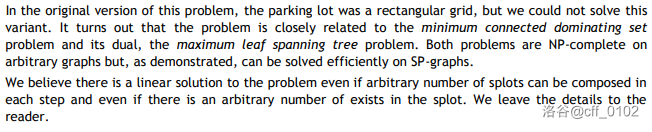
最后附一份官方出题组的出题背景:
 15011418730
LV 7
@ 2025-8-24 22:46:55
15011418730
LV 7
@ 2025-8-24 22:46:55
- 1
